Handmade Fish Balls vs Store-Bought — Can You Taste the Difference?
We explain why our QQ handmade fish paste balls are bouncy, fresh, and completely different from pre-packaged supermarket fish balls.
Francis & Esther
12 September 2025 · 5 min read
[AddInfographic]
Handmade Fish Balls vs Store-Bought — Can You Taste the Difference?
You know that specific bounce when you bite into a really good fish ball? It’s that split-second of resistance before the texture gives way to a savoury, sweet release of seafood flavour. That sensation is what Malaysians call “QQ”, and it is the holy grail of fish ball craftsmanship.
At Soooka Cafe, handmade fish paste balls are a cornerstone of our comfort bowls menu. This dedication to tradition transforms our porridge and noodle dishes into something far more memorable than a standard hawker meal.
Most people assume the difference is subtle, perhaps just a matter of freshness. But the reality is that commercial and handmade versions are effectively two different food groups masquerading under the same name. Let’s look at the data, the chemistry, and the reason we refuse to take shortcuts.
The Hidden Science of Store-Bought Fish Balls
If you walk into the frozen section of a supermarket in Malaysia, you will see packets of fish balls selling for as low as RM13 per kilogram. These products are marvels of food engineering, designed for shelf life and profit rather than flavour.
The primary ingredient in these mass-produced balls is often surimi, a highly processed fish protein concentrate. Industrial surimi production involves repeatedly washing minced fish meat until all fats, enzymes, and soluble proteins are removed. What remains is a bland, odourless protein lattice that can be frozen for months without spoiling.
The Chemical “Bounce”
To replace the flavour and texture lost during processing, manufacturers turn to chemistry. A standard packet often lists Sodium Tripolyphosphate (STPP), also known as E451. This additive forces the protein to hold onto water, artificially increasing the weight and creating a rubbery, super-elastic texture that never changes.
You might also find significant amounts of fillers. Studies on commercial Malaysian fish balls have found protein contents as low as 7.5%, with the bulk of the product being made up of tapioca starch, water, and ice. This explains why store-bought balls often taste sweeter and “flourier” than actual fish—you are effectively eating a fish-flavoured starch dumpling.
| Feature | Commercial Mass-Produced | Soooka Handmade |
|---|---|---|
| Primary Base | Frozen Surimi Block | Fresh Whole Mackerel & Yellowtail |
| Binder | Tapioca/Wheat Starch (High %) | Salt-Soluble Protein (Natural) |
| Texture | Uniform, rubbery, plastic-like | Springy “QQ” with natural grain |
| Additives | STPP (Phosphates), MSG, Preservatives | None |
| Cooling Reaction | Stays perfectly round | Shrivels slightly (natural contraction) |
What Makes Handmade Fish Balls Different
Our approach at Soooka is closer to what you might find in a traditional home kitchen or a legacy specialist shop. We rely on fresh fish—specifically a blend of Ikan Tenggiri (Spanish Mackerel) and Ikan Ekor Kuning (Yellowtail)—processed on the day of service.
The Importance of Fish Selection
We use Ikan Tenggiri for its legendary stickiness. The flesh of the Spanish Mackerel is rich in myosin, a protein that acts as a natural glue when handled correctly. Ikan Ekor Kuning is added for its superior sweetness and softer mouthfeel, balancing the firmness of the mackerel.
Commercial surimi is often made from “trash fish” or mixed bycatch that varies from batch to batch. By controlling exactly which fish goes into our paste, we ensure a depth of umami that comes from the fish oils, not a packet of MSG.
The “Slap” Technique
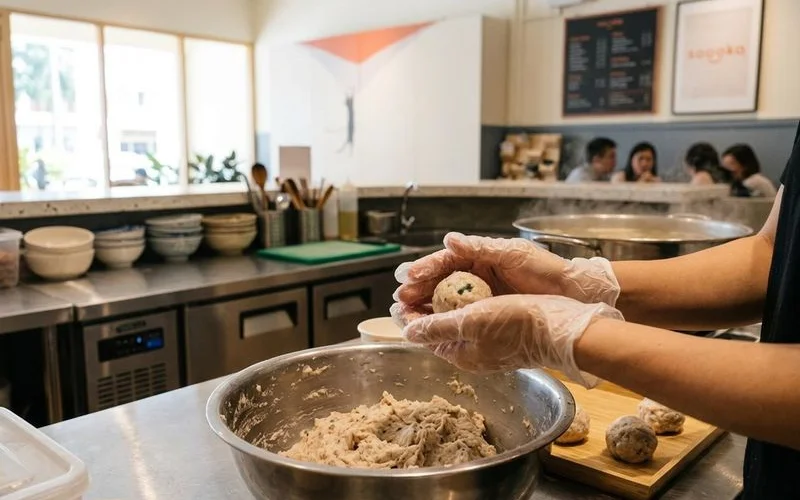
You cannot achieve the correct texture by simply stirring fish paste. It requires a violent, rhythmic throwing technique known as “slapping.” We lift the paste and throw it against the mixing bowl repeatedly.
This physical impact unravels the protein strands in the fish meat. As they unravel, they cross-link with each other to form a complex, springy network. It is this protein matrix that traps moisture and creates the “QQ” bounce naturally.
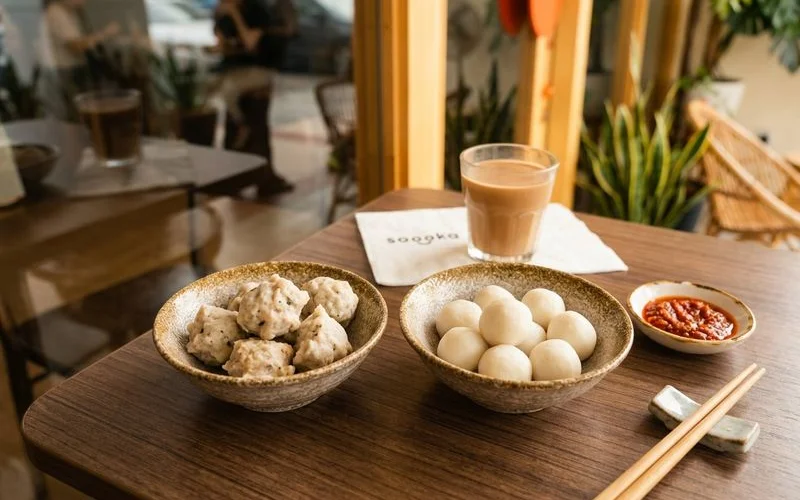
Insider Tip: You can spot a real handmade fish ball by the “wrinkle test.” When a proper fish ball is cooked and then cools down, it should shrivel slightly as the protein contracts. If a fish ball stays perfectly round and smooth like a ping-pong ball even when cold, it is likely packed with starch and stabilisers.
Minimal Ingredients
Our recipe is deliberately simple: fresh fish meat, salt, a dash of white pepper, and a hint of sesame oil. The salt is not just for seasoning; it is chemically necessary to solubilise the myosin and allow the paste to become sticky.
We do not use preservatives. This means our fish balls have a shelf life of roughly 24 hours, whereas commercial balls can sit in a freezer for up to two years.
How We Use Them at Soooka
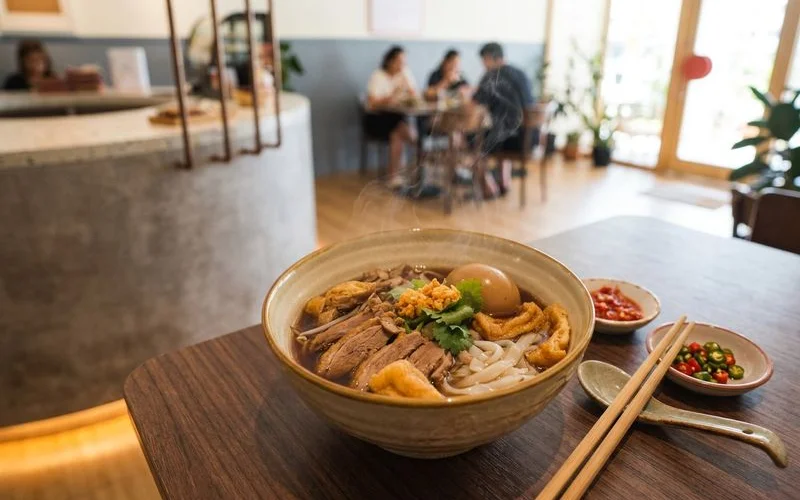
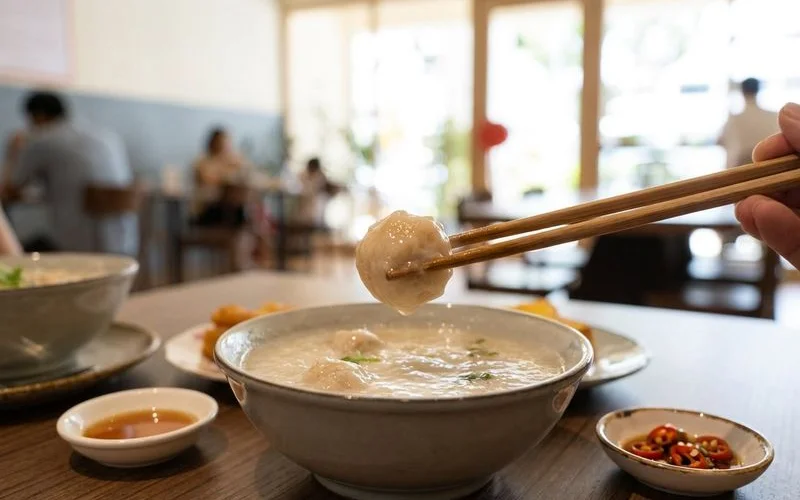
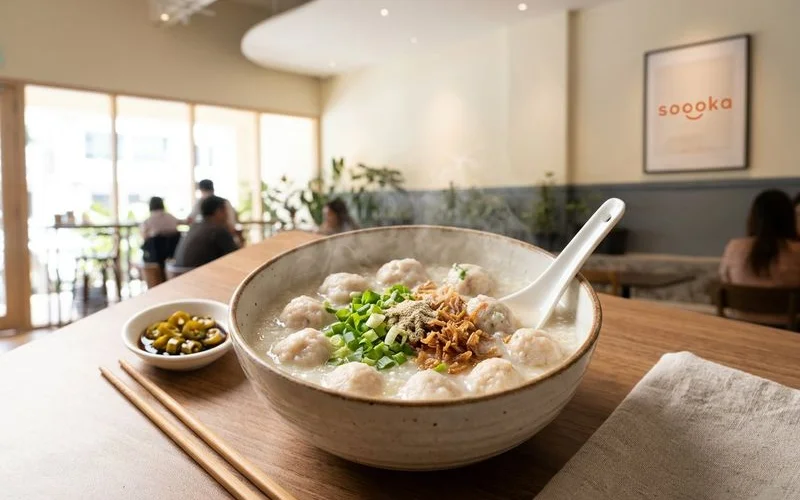
We feature these handmade creations as the star of our signature fish ball porridge. The dish is a study in texture, contrasting the silky, slow-cooked congee with the firm, bouncy bite of the fish balls.
The porridge base is cooked with ginger to cut through the richness. We then poach the fish balls directly in the gruel just before serving. This gentle heat ensures they remain tender; boiling them violently in a separate pot would tighten the proteins too much and ruin the texture we worked so hard to create.
It is a comforting, honest meal. Many of our regulars tell us it tastes like “grandmother food”—a compliment that confirms the extra effort is worth it.
The Cost of Doing It Right
There is a significant price difference between our method and the industrial route. A commercial packet of fish balls might cost RM15 per kilogram, while fresh Spanish Mackerel can cost upwards of RM35-45 per kilogram at the market—and that is before you account for the waste.
When you debone and skin a whole fish, you lose about 50% of the weight. We are left with a smaller yield of pure meat, which means the effective cost per gram is easily triple that of the store-bought alternative.
We accept this cost because the result is incomparable. You simply cannot fake the taste of the ocean or the texture of fresh protein.
Try the Difference Yourself
The only way to truly understand the gap between industrial surimi and fresh fish paste is to eat them side-by-side. If your palate has been trained on the rubbery, starchy texture of supermarket brands, the natural grain and sweetness of our version will be a revelation.
Visit our fusion cafe in Petaling Jaya in Damansara Perdana. We are open daily except Wednesdays, from 10am to 10pm (weekends from 8am).
Order the fish ball porridge and pair it with a specialty coffee for the ultimate brunch. It is a simple luxury that proves some things are still worth doing the hard way.
Explore More
View our comfort bowls menu →