What Makes Artisanal Cakoi Different from Regular Youtiao?
Discover the craft behind Soooka's signature cakoi — sourced from a master with 25 years of frying expertise. Learn what separates artisanal dough from mass-produced youtiao.
Francis & Esther
15 December 2025 · 5 min read
If you have ever bitten into a piece of cakoi and detected a faint whiff of ammonia or felt a greasy film coat your tongue, you have likely experienced mass-produced dough. At Soooka Cafe, our signature cakoi is the antithesis of that industrial product.
This is not just fried dough to us.
It is a craft perfected over 25 years by our dedicated specialist. Founded by a husband and wife team in August 2023, Soooka was built on the belief that even a humble snack deserves mastery.
But what actually separates the good from the great? The difference is found in the chemistry of the dough, the health of the oil, and the precision of the fry.
The Artisan Behind Our Cakoi
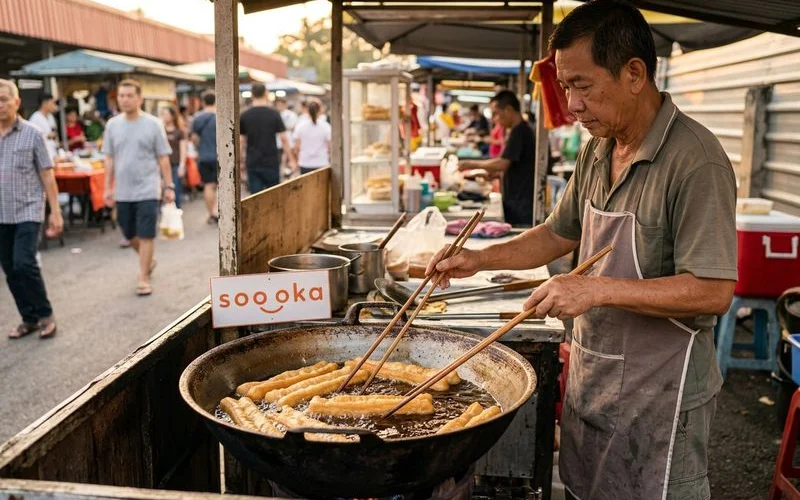
Our supplier is not a factory production line. He is a master craftsman who has dedicated a quarter of a century to the singular art of frying cakoi.
Most commercial suppliers rely on timers and automated mixers.
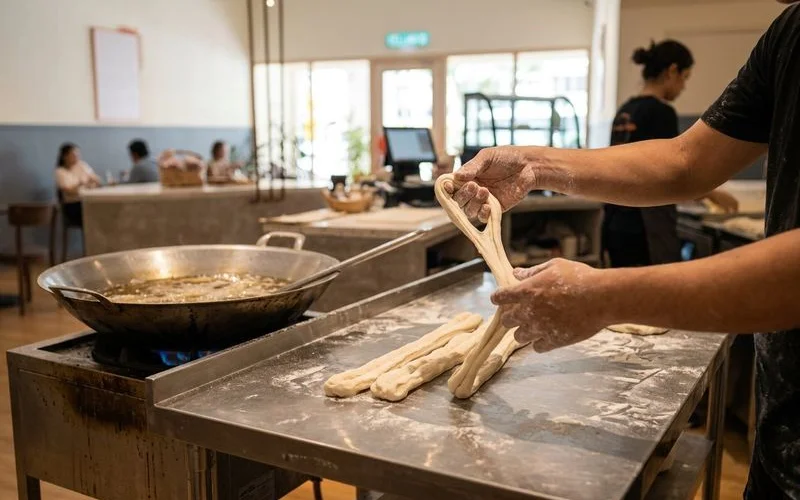
In contrast, our artisan relies on sensory intuition developed over decades. He adjusts the hydration of the dough based on the humidity of the air that specific morning. You can see this mastery in the way he handles the dough, knowing exactly how much tension to apply before it hits the oil.
Dough Science: Hydration and Chemistry
The most significant technical difference between artisanal and factory cakoi is the “hydration percentage”—the ratio of water to flour.
Mass-produced youtiao typically uses a low hydration rate (around 50-60%). This drier, stiffer dough is necessary because it must be sturdy enough to be extruded through industrial machines without sticking. The result is often a dense, bread-like texture with small, uniform air bubbles.
We take a completely different approach.
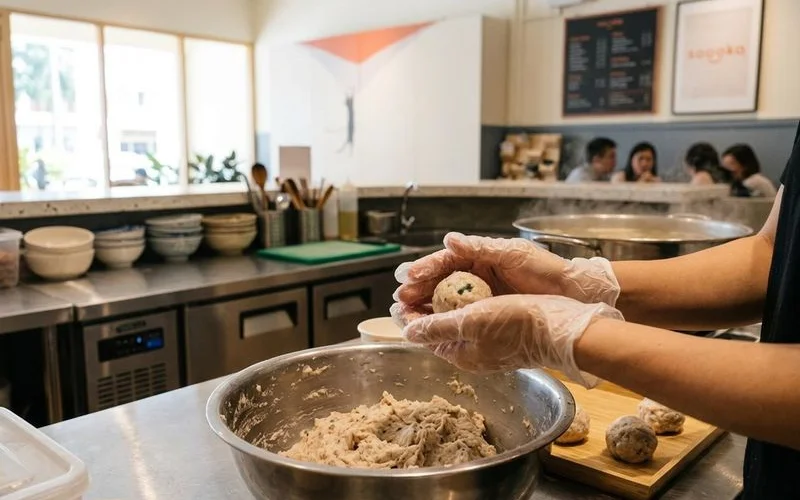
Our artisanal dough uses a high hydration strategy, often pushing towards 75-80% water content. This creates a wet, sticky dough that is impossible for machines to handle and must be shaped by hand. High hydration is the secret behind those large, irregular air pockets (known as alveoli) that give our cakoi its signature pillowy lightness.
The “Ammonia Smell” Test
Have you ever noticed a chemical odour in hawker stall youtiao? That is usually Ammonium Bicarbonate.
Factories use this powerful chemical leavening agent because it creates an explosive expansion in the fryer, making the cakoi look huge and airy despite using less dough. If the frying temperature is not perfect, the ammonia gas does not fully dissipate, leaving behind that unpleasant smell.
We refuse to use such shortcuts.
Our process relies on natural fermentation and aluminum-free baking powder to achieve lift. This takes longer and requires more skill, but the result is a clean, wheat-forward flavour with zero chemical aftertaste.
Comparison: Artisanal vs. Mass-Produced
| Feature | Artisanal Cakoi | Mass-Produced Youtiao |
|---|---|---|
| Hydration | High (75-80%) | Low (50-60%) |
| Leavening | Natural fermentation / Baking Powder | Ammonium Bicarbonate / Alum |
| Structure | Large, irregular holes (Open Crumb) | Small, uniform holes (Tight Crumb) |
| Texture | Crispy shell, moist interior | Hard crunch, dry or doughy interior |
Texture That Tells a Story
When you bite into a piece of our cakoi, you will experience a specific textural sequence. First, the exterior shatters—a micro-thin, golden shell that gives way instantly.
Inside, the dough is soft and slightly chewy.
This is the “mochi-like” quality that high-protein flour and high hydration provide. You can actually test this yourself. Press down on a piece of cakoi with your finger.
Factory youtiao will either stay flat (too dense) or crack apart (too dry). A proper artisanal cakoi will spring back slowly, indicating a healthy gluten network and proper moisture retention.
The Frying Process and Oil Health
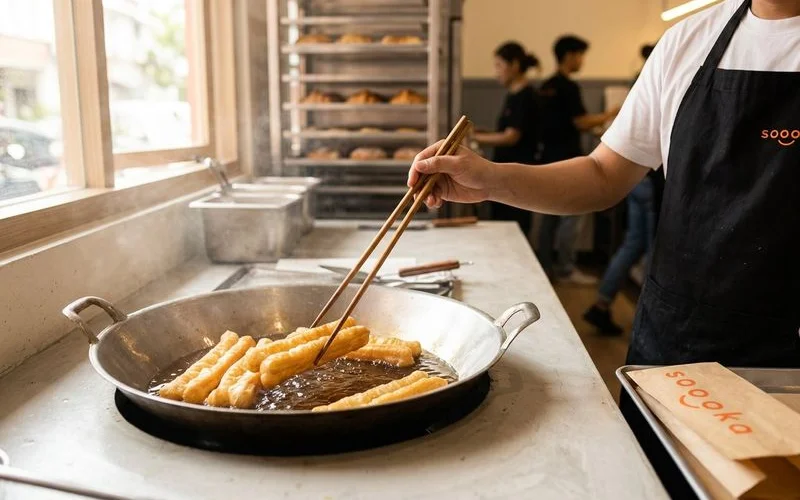
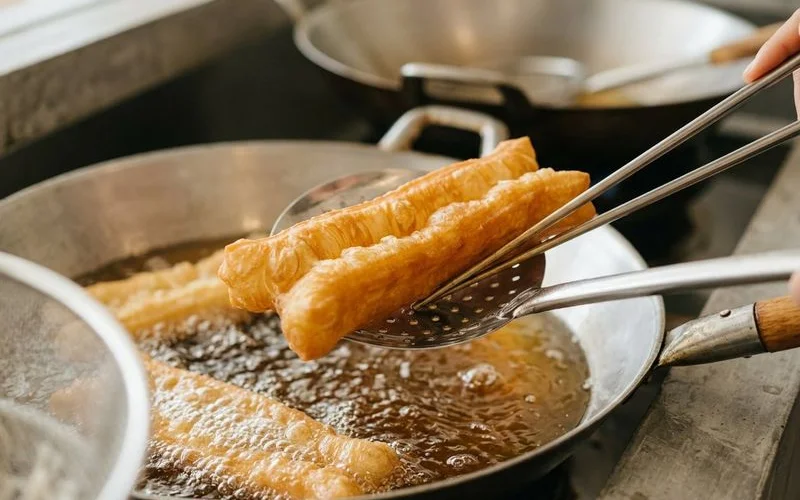
Temperature control is the final variable in the equation. Our artisan targets the “sweet spot” between 180°C and 190°C.
If the oil drops below 170°C, the dough acts like a sponge and absorbs grease. If it spikes above 200°C, the outside burns before the structure sets. Maintaining this narrow window requires constant vigilance and micro-adjustments to the flame.
The Danger of Reused Oil
Mass production often prioritizes cost over health, leading to the overuse of cooking oil. When oil is heated repeatedly, it accumulates Total Polar Compounds (TPC).
High TPC levels are linked to various health risks and give the oil a dark, viscous quality. You can spot this at stalls by looking for “stable foam”—bubbles that linger on the surface of the oil for a long time.
We maintain strict standards for our oil quality.
Fresh oil ensures that the cakoi tastes clean and light, not heavy or rancid. You should feel energized after eating it, not sluggish.
Why Freshness Matters
Cakoi is a fleeting pleasure. The starch molecules in the dough begin to retrograde (harden) the moment they cool down.
This is why large-scale producers often add preservatives or excessive stabilizers. They need their product to survive hours sitting in a display case.
When you order at Soooka Cafe, you are often eating a batch fried that same morning. We do not use heat lamps to artificially extend the life of a stale product. The difference is immediately apparent in the “snap” of the crust.
How We Serve It at Soooka
We believe that great cakoi deserves thoughtful accompaniment. Our menu is designed to balance the richness of the fried dough with contrasting flavours.
Here is how we elevate the experience:
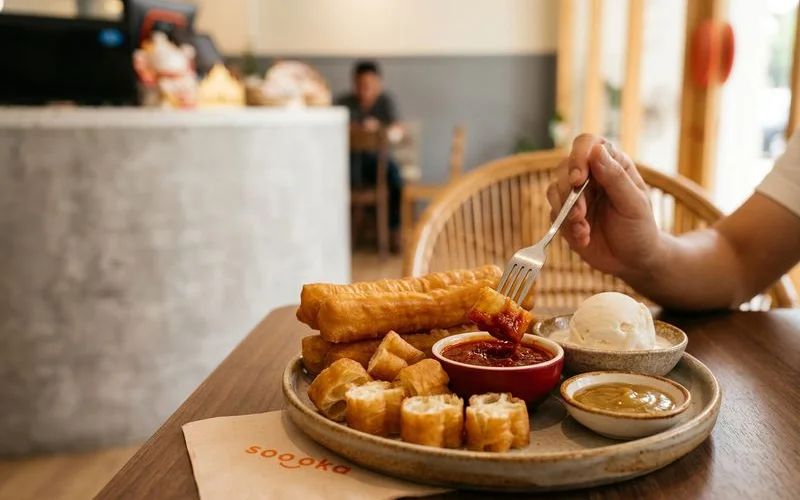
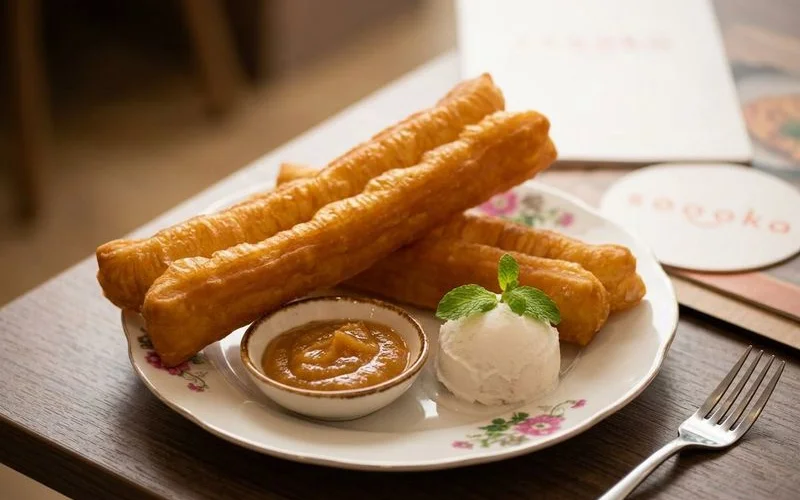
- Classic Dipping: Served with our house-made kaya and a rich, creamy coconut dip. The sweetness cuts through the savoury notes of the dough.
- Savoury Stuffed: Our Chili Prawn Cakoi fills the hollow centre with a spicy, umami-packed prawn paste, turning a snack into a satisfying meal.
- Sweet Indulgence: Paired with coconut ice cream. The hot, crispy dough against the cold, melting cream creates a temperature contrast that is hard to beat.
Each of these pairings highlights a different quality of the signature cakoi—the crispness, the chewiness, and its ability to absorb flavour.
A Tradition Worth Preserving
Choosing to work with a single artisan in an era of automated production is a deliberate choice. It costs more.
It requires complex coordination.
And yes, it means we sometimes sell out because a human being can only fry so much dough in a morning. But this constraint is a sign of quality.
When you taste our cakoi, you are experiencing the result of 25 years of devotion. That human element is the secret ingredient that no factory can synthesize.
Come taste the difference for yourself at our fusion cafe in Petaling Jaya. We are open daily (except Wednesdays) from 10am to 10pm, and on weekends from 8am.
The first bite will tell you everything you need to know.
Explore More
View our signature cakoi menu →